Saturday, March 3, 2018

Flâneuse: Women Walk the City in Paris, New York, Tokyo, Venice and London by Lauren Elkin

2 Stars


Historical retrospective of cities and the literary women who haunted their avenues with overlays of Elkin's experiences.

This is more biographical than geographical. Elkin explores feminism through the lens of authors' lives and their writings. Specifically, women's use of city space or exclusion from it. It has strong associations to arguments of female confinement and the interiority of their lives, but Elkin emphasizes the subversion of it by artists and writers from historical periods.

New York
Twenty pages and only two that actually discuss walking the city, the rest covers nearly everything else but flaneusing.

Don't think I don't see the irony in complaining about the lack of focus in a book titled Flaneuse. But, I took it literally, as an armchair adventurer not as a disjointed treatise on everything from Post World War II architecture, to postmodernism, to feminism, to the epiphany that, "I've lived in a cage and never realized it!" experiential sharing.

Paris
Twenty five pages and maybe one that discusses walking the streets contemporaneously, from a firsthand account. The rest is a dissection of Jean Rhys' literature oeuvre with a provocative counterpoint of Hemingway and a dash of Ford. I haven't read Rhys and I can tell from the analysis provided I'll despise her books--women in penumbral spaces who continually make the worst choice possible-- dear god, yes, why wouldn't I love that?

London
Virginia Woolf and the Bloomsbury Group. Again, more literary than actual discussion of London. That said, I was very familiar with the area discussed so I enjoyed moments of flashbacks. Plus, I like London.

Paris Deuxième
This revisit features George Sand and her radical flight to Paris in the early nineteenth century, leaving behind her children to pursue her writing and political ideals only to return to the countryside in Berry after the unrelenting bloodshed of Paris power struggles. Sand refocusing on themes of matrimony and education as the liberator of women. Again, there are brief, one line ties in to contemporary Paris but that is it.

Venice
Diary entry about Elkin's PhD avoidance by writing a novel set in Venice instead of a thesis. Clearly, firsthand experience required. Sophie Calle turns out to be a source for character development and the reader gets to run down this rabbit hole. Turns out Sophie liked to follow interesting looking strangers around the city, see where they went--which to be honest, I've done while wandering various cities myself so I can't knock it. The idea is that someone that interesting looking must be going somewhere interesting. Where? Alas, not always true, but I found strange nooks and crannies with unique shops, festivals, and even dreary financial districts utilizing this method.

Tokyo
I feel like Elkin and I are on opposite ends of the spectrum; I would take Tokyo in a heartbeat over Paris--any day. This section is primarily a diatribe about how much Elkin hated Japan and everything about it with a backdrop of her destructing relationship. The part that really drove me nuts was that for a person who travelled the complaint that the real Japan couldn't be found dumbfounded me. Like everywhere else in densely populated cities, jump on the Metro, Tube, subway and go!

Paris Troisième
God, I don't like Paris, and certainly not enough to start the third chapter of its history and effusing over its "charm". I'm tapping out of this book, page 150. My library loan is about to end and I just don't have the desire to continue on.

This is probably a fantastic read for people looking for an author biography and feminist discussions of restricted space. Just know that it tends towards tossing out philosophical concepts like confetti as it meanders. Either you find it pretentious or a clever tie-in. I clearly had incorrect expectations and while I found it interesting, Paris killed it for me.

Overall, strangely intimate editorializing, but then since complete strangers often share oddly intimate details of their lives unprompted on street corners waiting for lights or deli counters and parking lots this wasn't as weird as it could have been.



Gentleman Nine by Penelope Ward

1 Star


So not what I was hoping for after reading the blurb.

The romance genre is mostly a miss for me nowadays. I went in looking for some nostalgic and smexy loving and I got this emo and way more chaste story than I expected with a blurb flogging escort services and playboy ex-crushes. Actually, I call FLAG on the play!

This was bait and switch. 

A virgin adjacent and a reformed rake comprise this story that has A LOT of emotional baggage. Add on that these two mid to late twenties individuals act at times like they're a decade younger and you get a weird faux teen angst story. The alternating first person point of view did it no favors since it was the crutch that made the story all internal monologuing and fretting. It took this story from two stars to one. 

Finally, there were some plot points that made me roll my eyes so much that I nearly got eye strain. I know they're my peccadillos, but they just rubbed me the wrong way. Spoilers abound so not going into to detail, but if this is a real thing for people, then I don't want to know how messed up people are about human bodies and their function. And they shouldn't be characters in a book advertising itself as a racy romance. 

Maybe I can't read blurbs correctly anymore, but whatever this was I didn't like it.


Two Man Station by Lisa Henry

3 Stars


City life didn't prepare Gio for this.

Gio's professional life has thrown 180 and he's been offloaded to the hinterland. He's trying to make the best of it, but his past won't stay past, and soon the present seems very different.

This is an armchair romance with a slow burn and easy meander because country life ain't city life. Henry does a bang up job painting the isolation, quiet, and stark beauty of the Australian outback. The politics of small town policing has a learning curve as Gio finds out.

This is more a character study story than a police action, or rather it focuses of the everyday minutiae of police work, the unglamorous and unsexy. Not to say that there isn't a burr in the ointment. Gio's got problems, but he's not the only in Richmond, and when the humdrum of everyday breaks--it's fast and merciless. Don't be fooled by the quaint.

This almost feels like it could be the beginning of a series because while there's resolution there's enough threads to pull and follow on in subsequent books. Recommended for those looking for conflicted and heartfelt heroes in a setting that dominates the story.


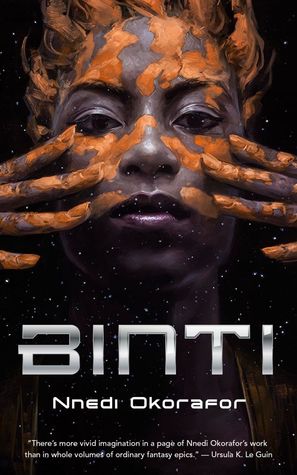
Binti by Nnedi Okorafor

3.5 Stars


Transformation has a cost.

This was a lovely novella. Short, but packed with so much world building, action, and resolution. Okorafor gives the reader a wonderful vision to explore with a daring protagonist. Binti is a classical hero story that takes technology, an African perspective, and weaves it into a sci-fi/fantasy. Issues of sacrifice, race, culture, and how differences can coexist within a framework of respect dominate this first of the series.

Definitely continuing on even though young adult is usually not my favorite. The rating is really 3.5 stars. If I judge this as an adult story it's 3 stars and closer to 4 stars as a YA/NA novella.

And I LOVE this cover. Gorgeous. Perfect for the story, too.


Defiance: The Extraordinary Life of Lady Anne Barnard by Stephen Taylor

3 Stars


An in-depth biography of Lady Anne Barnard nee Lady Anne Lindsay.

For a woman of her time period she was eccentric and skirted traditional values and social norms. This account portrays an intelligent woman of minimal means who rose to ply the drawing rooms of the intelligentsia. Her sharp mind and quick wit more than countered her reduced financial means, and if she had been a man the world would have been her oyster. As it is, being a woman was a significant liability. Nonetheless, she managed to avoid the pitfalls and carve out a life she would be happy to live, not one the world and her circle of peers would have necessarily picked.

It got a bit gossipy, but then Georgian England lived for it, and the French Revolution did nothing to downplay the dramatic events unfolding. Add in her experiences in South Africa and the battling sides in colonialism and you can see that there were many traps. 'May you live in interesting times', yeah, it's not hard to see how this is actually a curse. But the book gives a solid overview of political events driving peoples' lives, including Lady Anne.

While I can't call this upbeat, and I'd never wish to have been in her shoes, it is intriguing to see how she managed/mismanaged all the balls including matrimony. Overall, Taylor's approach is very sympathetic and lionizes Lady Anne Barnard.

Africa took Anne back to the innocence of childhood, wandering in an elemental place almost like the girl who once rode a pig at Balcarres.

Wednesday, February 14, 2018

Beren and Lúthien by J.R.R Tolkien, Christopher Tolkien ed.

3.5 Stars

A labor of love. Not just Beren's feats to win Lúthien, but also Christopher Tolkien for his father and his apparently enormous oeuvre. This is an archivist's weaving of the fragments of the tale of Beren and Lúthien from a selection of separate works to relay the most complete, yet, not rewritten telling of this love story.

The verse in the various cantos and Quenta is lyrical, mesmerizing, and beautiful. While the publisher pushed Tolkien for prose and the result, The Lord of the Rings, is wonderful, the verse and Tolkien's love of heroic poetry is resplendent.


'Be he friend or foe, or demon wild
of Morgoth, Elf, or mortal child,
or any that here on earth may dwell,
no law, nor love, nor league of hell,
no might of Gods, no binding spell,
shall him defend from hatred fell
of Feanor's sons, whoso take or steal
or finding keep a Simaril.
These we alone do claim by right,
our thrice enchanted jewels bright.'

Or:

From wall to wall she turned and wheeled
in dance such as never Elf nor fay
before devised, nor since that day;
than swallow swifter, than flittermouse
in dying light round darkened house
more silken-soft, more strange and fair
than sylphine maidens of the Air
whose wings in Varda's heavenly hall
in rhythmic movement beat and fall.

While this is a self-contained telling of the story of Beren and Lúthien pulled from various works and unpublished pieces, the largest being "The Lay of Leithian". I still feel like I might have been better off if I had read The Silmarillion, first. It's not that Christopher Tolkien does a bad job, if anything I think the work and dedication clearly evident in pulling the fragments together into a coherent whole is admirable, but there is context that I'm missing. Nonetheless, watching the story change as the years progress is very interesting.

Tolkien's love of language is at the forefront and there are so many things which tickled my brain as I read. Various references to Norse mythology, Rapunzel theme with Tinúviel, and an interesting interplay between Chinese and Japanese, which in a post-WWI context would be fun to explore further. I do like to see the hints of history that pepper through his work.

Huan, Hound of Valinor means "change" in Chinese, a great wolfhound that is pictured on the cover. He is a critical character in the story. Beren's trial include being thrall to the evil Prince of Cats, Tevildo which in one variant is referred to as Ainu, name of the indigenous peoples of Japan. So, there are definitely political themes relevant to Tolkien referenced. Frankly, I'm curious if the added storyline of Kili/Tauriel in the Hobbit movie was influenced by Beren and Lúthien.


There are some lovely image plates accompanying the story. I recommend this for Tolkien fans only.


Monday, February 5, 2018

Global Discontents: Conversations on the Rising Threats to Democracy by Noam Chomsky

4 Stars


Understanding global politics is like string art; it's not complete until you can see all the threads intersect.

Chomsky lambasts nearly every nation state that makes the news in this book, both U.S. political parties, and if you can't comprehend the United States as an imperialist power then this book is going to be a huge miss for you.

Chomsky's the person that stands up and says, "The Emperor is Naked".

You've written about a "democracy deficit"

"Deficit" is an understatement. Iran just had an election, and people criticized it, rightly, because you can't even enter Iranian political system unless you're vetted by clerics. That's terrible, of course. But what happens here [US]? You can't enter the political system unless you're vetted by concentrations of private capital. If you can't raise millions of dollars, you're out. Is that better?


This exemplifies the discourse within the book. Questions or thoughts are posed for Chomsky to extrapolate on. The sections include: State Spying and Democracy; A Tour of the Middle East; Power Systems Do Not Give Gifts; ISIS, the Kurds, and Turkey; Living Memory; Fearmongering; Alliances and Control; The Roots of Conflicts; Toward a Better Society; Elections and Voting; Crises and Organizing; The Trump Presidency.

Rocker wrote, "Political rights do not originate in parliaments, they are, rather, forced upon parliaments from without."

From below, in fact. I think that's an accurate comment. Power systems do not give gifts willingly. In history, you will occasionally find a benevolent dictator or a slave owner who decides to free his slaves, but these are basically statistical errors. Typically, systems of power will try to consolidate, sustain, and expand their power. That's true of parliaments, too. It's popular activism that compels change.


You said in a recent interview that U.S. policies have "succeeded in spreading jihadi terror from a small tribal area in Afghanistan to virtually the whole world, from West Africa to Levant to Southeast Asia. How did they do that?"

When the only method you have is to use your comparative advantage in violence, you will always make the situation worse. The military analyst Andrew Cockburn points out that every time you kill a leader, you think it's a big triumph. But what you're doing, almost invariably, is replacing him with a younger, more competent, more violent leader. It happens over and over.


So, when people say these actions are free recruitment advertising; they're serious. The question that Chomsky keeps coming back around to is what is your objective? Sometimes solving a problem isn't the fun or palatable option and the money game makes everything worse.

"When you're an activist, you have to think about the people you're trying to protect, and not just make yourself feel good."


I recommend this book if you're still working out a comprehensive worldview because Chomsky does a good job highlighting cause and effect in essentialist terms. Short, sweet, and to the point.


Favorite quote:
The efforts that go into trying to ensure the end of humanity are impressive. If there were somebody from outer space watching this, they could only conclude that humans are an absolutely unviable species, an evolutionary error tending toward self-destruction.