
Wednesday, October 31, 2018

Tuesday, October 30, 2018
Overtime (Laundry Files, #3.5) by Charles Stross
3.5 Stars
I was going to save this for Christmas, but since I have no self control...Done!
Oh my, Bob. This is a funny take on holiday traditions from childhood to office.
Whoever sat on the copier lid that time did not have buttocks, hairy or otherwise--or any other mammalian features for that matter. What I'm holding looks to be the business end of a giant cockroach.
Again, a certain Lovecraftian charm/terror, whatever you want to call it. Only thing missing were the Christmas crackers.

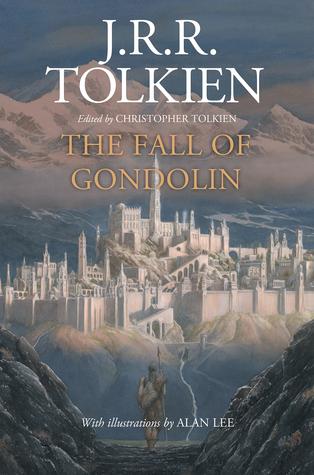
The Fall of Gondolin by J.R.R. Tolkien, ed. Christopher Tolkien
4 Stars
I finished this as the grey light of morning waned and gold pierced through the fog. The Fall of Gondolin tells of the downfall of last enclave of Noldoli, Deep Elves, who escaped Melko after the Battle of Unnubmered Tears. Christopher Tolkien has taken on the monumental task of trying to piece together the fragments of a multitude of versions pertaining to Gondolin and Tuor, hero who's line will yield both Elrond of Rivendell and Elros, the King of Númenor.

Beside the insight into the creation process of Tolkien, I really enjoyed The Fall of Gondolin more than Beren and Lúthien because of Ulmo's major role. As God of Water we get many descriptions, those along the sea I loved most and I think anyone who has ever heard the call whispered upon the waves understands this:
Eärendel is born, having the beauty and light and wisdom of the Elfinesse, the hardihood and strength of Men, and the longing for the sea that captured Tuor and held him for ever when Ylmir spoke to him in Land of the Willows.
I think that if you are not heavily invested into the mythos and history of Middle-Earth, then this is not a book I recommend. While the weaving of the versions, observing the changes between them and how they evolved, and what was cut and what was not is fascinating, if one does not have at least a moderate understanding then it will be needlessly complex. This doesn't mean that C. Tolkien does a bad job, but rather it circles back again and again and if one doesn't like to see how sausage is made then best to just read the first version and call it quits.

J.R.R. Tolkien did not want to publish The Hobbit's sequel, Lord of the Rings without publishing The Silmarillion, he intended it to be the Saga of the Jewels and the Ring, but postwar Britain being what it was in the fifties with shortages and rationing that was not practical. He held out, but eventually, he gave into the publisher: "Years are becoming precious. And retirement (not far off) will, as far as I can see, not bring leisure but a poverty that will necessitate scraping a living by 'examining' and suchlike tasks."
I feel a compulsion to read the Silmarillion and reread the Lord of the Rings again in order, which is rather frightening because that should be close to a million words--and there are so many things I haven't read. But, I feel like I've done this all wrong and I don't like it one bit and the only way to right it is to reweave the stories as they should have been in my mind. *sigh*
Seriously, there's indications that Legolas unless it is a different Legolas is elder to Elrond. Legolas retreats with Elrond's father, Eärendel, as a babe from Gondolin.
Friday, October 26, 2018
A Story Within a Book
There's a different space that can be found inside of shared books. Whether it's a library book or one picked up used, there are often echoes of the people who have read it before you. This can be interesting, a conversation across time and space. Or, it can be wildly distracting if someone has gone wild with a highlighter. And then, there's the instance where you find a whole different narrative, a story within a book.
That's what this post is about. A narrative within a library book. The book is Propaganda: The Formation of Men's Attitudes by Jacques Ellul, copyright 1965. Also critical is that this library book is part of Los Angeles County Public Library and Compton Library collection. Why that is useful information will become obvious.
Regardless, while I'm not a proponent of defacing library books this feels like a message in a bottle. A voice speaking out whether or not anyone is listening, but no doubt, hoping.


Reading through the comments, it appears that they were made in the mid eighties. I am not critiquing the comments or the book, but merely sharing this message in a bottle.
That's what this post is about. A narrative within a library book. The book is Propaganda: The Formation of Men's Attitudes by Jacques Ellul, copyright 1965. Also critical is that this library book is part of Los Angeles County Public Library and Compton Library collection. Why that is useful information will become obvious.
Regardless, while I'm not a proponent of defacing library books this feels like a message in a bottle. A voice speaking out whether or not anyone is listening, but no doubt, hoping.


Tuesday, October 16, 2018
In Other Words: A Language Lover's Guide to the Most Intriguing Words Around the World by C.J. Moore
3.5 Stars
This is one of those little books of curiosities. A lingual wunderkammer, an armchair traveler's delight. Short and easy breezy fun to pick through, and a perfect selection for times of constant interruption. Arranged geographically for the most part except for a section that just pulls out ancient languages. I think the advantage in this is brevity that avoids making it seem like reading a dictionary--which I totally did as a child.
Basque akelarre, 'the meadow of the male goat' or a nighttime gathering of a coven of witches.
German, way too many to choose from with their ingenious compound words, but drachenfutter, offering of errant husbands, literally dragon fodder.
Czech litost, "a state of torment created by the sudden sight of one's own misery".
Swedish bejaka, seems a more difficult one to grasp, but it seems to be along the lines of an optimism, acceptance of life and its vicissitudes.
Norwegian nidstang, a runic cursing pole used for vengeance. Hmmm... yes, like voodoo dolls, but instead of weaving the cursing in a totem you get to carve it deep. This is appealing, unfortunately, I live in less arboreal clime. Seems to be a variation of disturbing the earth spirits, like Icelandic's alfreka.
Tshiluba (Rep. of Congo) ilunga, "describes a person who will forgive any transgression a first time and then tolerate it for a second, but never for a third time".
Chinese gagung, "bare sticks" or "bare branches" are males who won't marry because of the one-child policy and gender imbalance result.
Japanes yokomeshi, "meal eaten sideways" or the stress of speaking foreign Western language with its horizontal layout.
Gaelic sian, haunting music heard from fairy hills, soft, sorrowful and enchanting.
Tierra Del Fuego mamihlapinatapei, shared look in a private unspoken moment, romantic, funny, or understanding.
Rating this seems odd. I liked the layout, it worked well. Some languages there were few words that I wasn't familiar with; Moore selected terms that have been incorporated into English and so those entries seemed weak by comparison.

Monday, October 15, 2018
The Sentinel by Arthur C. Clarke
3 Stars
As part of my Kubrick Oktoberfest, I read The Sentinel to compare it to 2001: A Space Odyssey. And this is why short stories make the most satisfying movies; they give indelible frameworks from which the director/screenwriter/crew can embellish, provide a variation on a theme if you will. Clarke cowrote the screenplay with Kubrick. I prefer adaptations that are changelings and not mimics, and Kubrick did a brilliant montage from Clarke's inspiration.

Much shorter than I expected. I feel rating this might be unfair because I came to this after seeing the movie, which is a much more expansive narrative, but I admire the springboard that it provided.
Wednesday, October 10, 2018
Pandemic 1918: Eyewitness Accounts from the Greatest Medical Holocaust in Modern History by Catharine Arnold
4 Stars
This is a chronological retracing of the Spanish flu progression 1917-1918. Depends heavily on witness and survivor stories from medical records to diaries. Arnold uses these accounts to give voice to it, to take it out of the medical jargon and relay the human effect. The pandemic swept up victims indiscriminately from the rich and famous: Gandhi, Lloyd George, Franklin D. Roosevelt, Lillian Gish, who were all fortunate, to those who died without anyone to identify them listed in registries as Polish woman, girl.
In northern territories the frozen ground made burial impossible, so to keep them from predation they stacked them in cabins like corded wood, but '[s]ome corpses were wrapped in sheets and placed on rooftops, creating a vista of ghostly shrouds until they could be buried in the spring.'
'When their lungs collapsed, air was trapped beneath their skin. As we rolled the dead in winding sheets, their bodies crackled - an awful crackling noise which sounded like Rice Crispies [sic] when you pour milk over them.'
[S]ix-year-old John Delano [...] lived down the block from an undertaker, and he began to witness coffins piling up on the sidewalk outside the morgue. As the piles of the coffins rose, he and friends played on them, jumping from one to another: 'We thought - boy, this is great. It's like climbing the pyramids. Then one day I slipped and fell and broke my nose on one of the coffins. My mother was very upset. She said, didn't I realize there were people in those boxes? People who had died? I couldn't understand that. Why had all these people died?'
Egon Schiele's portrait of wife Edith as she lay dying.

He died a couple days after her.
[A] little boy who, feeling the pinch of hunger, went to ask the butcher for some meat. He then asked the butcher how to cook it. The butcher asked why his mother wouldn't be cooking it. The little boy replied that his parents had been asleep in bed for two days. The butcher accompanied the lad home to find that they were asleep permanently.
As might be expected, this had a profound effect on witnesses and survivors. Thomas Wolfe's Look Homeward Angel includes a vivid description of his brother's death. Katherine Anne Porter's short story Pale Horse, Pale Rider was inspired by her own near miss.
Fast and deadly, the round of flu that swept through the autumn of 1918 killed people within the day of falling ill. I spent most of the time that I was reading imagining the consequences in today's numbers, but the real 1918 numbers were frightful enough; Persia was estimated to have lost 10% of its population.
10%. TEN PERCENT. That's decimation.
If that were the US today that would 32.7 MILLION people.
This is powerful and terrifying to read. I thought Mozart's Requiem the perfect accompaniment, if morbid considering he died while writing it. If you want the human experience, then this is a good selection.

Subscribe to:
Posts (Atom)